Smartphone Upgrade Trends in the Philippines 2025
The current smartphone market is saturated with new releases every year. Each generation presents a technology bump, coming from the old Nokia’ and Blackberries of yesteryear we are now enjoying and honestly spoiled with so many features on our phones. The rapid release of new tech, and increasing demand for the latest and greatest led to faster upgrade path from users. Where are we now? What is the state of smartphone upgrade trends in the Philippines?
In this article, using Inquiro’s data on smartphones of millions of anonymous users across the country, we will explore these topics:
-
Breakdown of device age per age group of their owners.
-
Are Iphones really the king of longevity among smartphones?
-
What is the state of top smartphone brands in the Philippines?
To begin, when we say device age, this is the age that the smartphone is released. So if a phone (We’re going to use just ‘phone’ from now on) was released in July 2021, even if it was sold and used in July 2022 it will still count as 1 year, since it was released in 2021.
In addition, if the owner decided to upgrade the phone and give it to their nephew, the phone will continue to accumulate it’s device age. The device age then, is a reflection of how old a phone can be so that it is still considered useable for that particular owner.
Let’s look at the case of device age per age group.
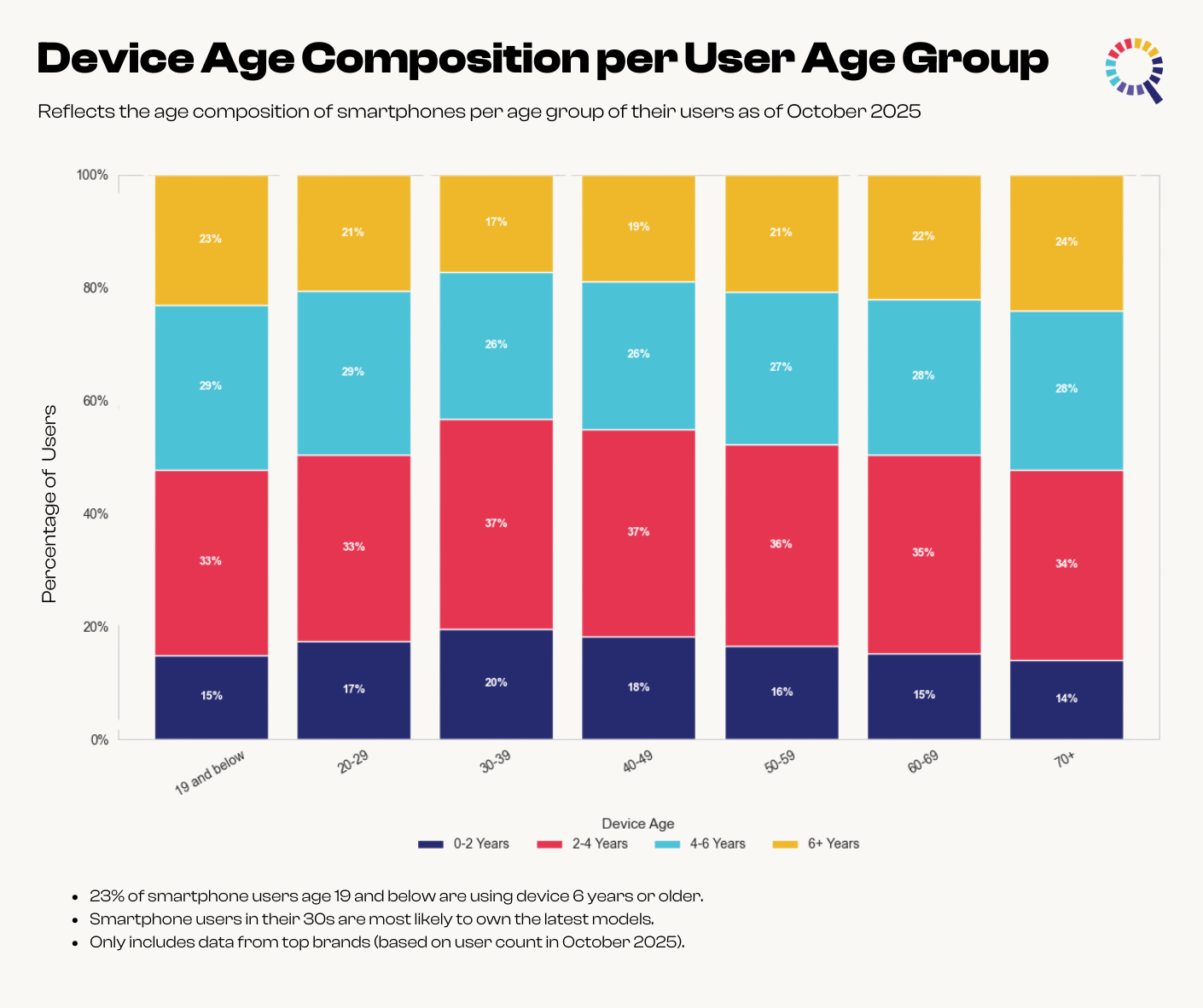
Device age per age group
Adults aged 30–39 typically own much newer phones than other age groups. More than half of these users daily drive a phone less than four years old (for reference, the Samsung S21 and iPhone 13 hit the market less than four years ago).
Older folks often keep much older phones and may feel content with them. Seniors over 70 hold the highest share of smartphones aged six years or older at 24%. On the other side of the spectrum, younger users use older phones as well, with 23% carrying a device aged six years or older.
Affluence drives the trend of young and middle-aged adults owning newer phones. This age group holds steady employment, maintains tech awareness, and often joins plans that incentivize newer models. Meanwhile, financial limitations prevent younger users from buying newer models, or they simply accept hand-me-downs. Senior smartphone users follow a similar pattern, though a lack of tech awareness often stops them from seeking the latest devices.
Phone brands and device age
It’s interesting to imagine which phones are being used for longer period of time. We are under the impression that Iphones are the king of longevity, so we created this chart to find out.
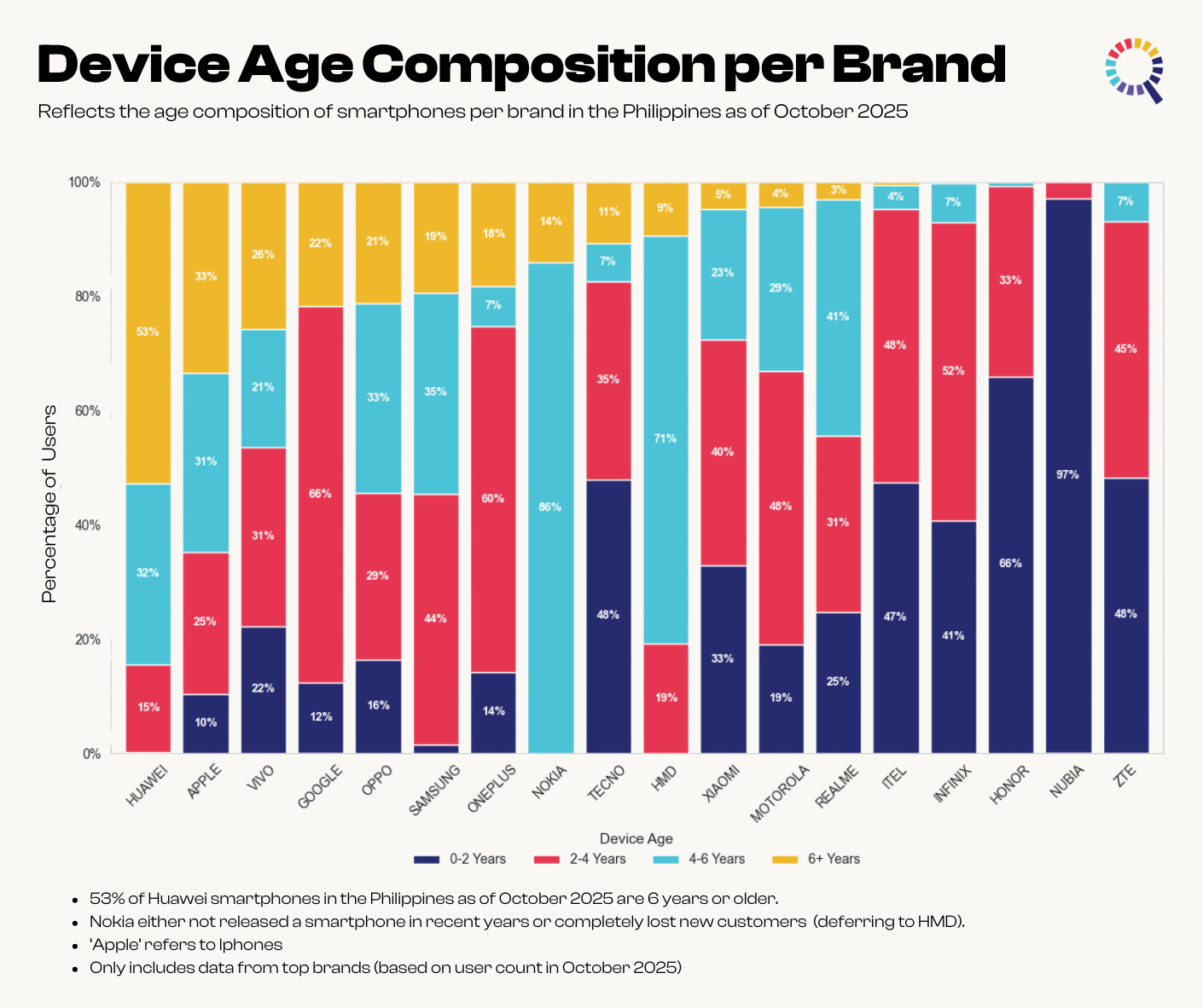
Huawei smartphones have the highest share of units that are 6 years or older. More than half of Huawei smartphones that are actively being used today are more than 6 years ago. Around that same time, Huawei lost a huge market share internationally due to sanctions. Still, Huawei users are holding on to those smartphones, a testament of their reliability despite their age.
Now finally to the people’s choice of longevity, Iphones (labelled Apple in the chart). If you search online on which smartphone brand will last you the most, Iphones will come out ahead most of the time. Our chart reflects this sentiment as 33% of all Iphone units in November 2025 are 6 years or older. For better context, those are Iphone X or older. If you are still using Iphone X or older, there’s only 33% of you out of all Iphone users.
Iphone had a relatively weaker release in recent years as seen in the chart. Recent Iphones (0-2 years old) make up only 10% of the entire base. In comparison, Vivo had a great year among smartphones with huge 6 years or older users. Vivo have a very favorable position in the market, with a fairly balance spread of smartphone generations. They are consistently delivering devices that people want to buy, and keep.
Google had a peculiar spread of smartphones, with practically no phones 4-6 years ago. There must be something about those Pixel 4 and 5 devices that made them obsolete even faster than Pixel devices 6+ years ago. I got a Pixel 7 which belongs to 2-4 years and I personally do not feel like upgrading anytime soon. This is reflected in the chart as Google had a very strong hold of devices 2-4 years old with a staggering 66% share.
On the other hand, Xiaomi are doing really well on selling their newer models while keeping a respectable share of phones usable for 5% of users.
This made me rethink of what this chart actually mean and its potential on keeping track on how different smartphone brands are performing.
State of smartphone brands
This chart is a not necessarily a longevity chart. We are basing our longevity insight on the share of units from a particular brand lasting more than 6 years. If a brand then, for example Iphones, have sold many new units, then it would eat up on that share. That will make the share of those 6+ year old phones lower, even though they are still using the units. A snapshot then, is not enough. Looking at the different brands, it is complicated to measure and thus the numbers we get needs a lot of context.
What this chart is great at is identifying trends per brand. It reflects the fact that Nokia essentially stopped selling smartphones in the last few years, together with HMD. Nubia on the other hand, is an emerging brand in the country and thus shows a 97% share of 0-2 year smartphones in the market. The chart shows that despite their decade long release of phones, ITEL, INFINIX, and ZTE have very few users holding on to their older lineup. It is hard to know why this happened, as there could be a lot of reasons for this trend. But if we are a smartphone brand, it could valuable to know these trend among my competitors.
Summary
Using data from Inquiro, this article examines smartphone longevity and ownership trends across different age demographics in the Philippines. The analysis reveals that adults aged 30–39 own the newest devices due to higher purchasing power, while seniors and younger users are more likely to use older models or hand-me-downs. Brand-specific data shows that Huawei and Apple lead in longevity, with significant portions of their user bases maintaining devices released over six years ago. Conversely, emerging brands like Nubia show a high concentration of new models, while others like Google and Xiaomi demonstrate varied retention rates based on specific release cycles. Ultimately, the study suggests that a brand’s “device age” profile is a complex reflection of both hardware durability and shifting market trends.
It is important for businesses to know their customers well. Inquiro can help remove the guess work and target the right people for campaigns. If you’re doing a campaign for a new phone release, you would probably love to know the age demographic of potential smartphone buyers, their interests and purchasing behavior. To learn more about our products, contact our team to find the best solutions for you.