Philippines Smartphone Insights: iPhone Upgrade Paths in 2025
While smartphone lifecycles are lengthening, Apple users remain some of the most loyal consumers in the tech world. Our research shows that many users hold onto their devices for record periods—some even still utilizing the iPhone 4, a device released 16 years ago. However, every user eventually reaches a “breaking point” where a smartphone upgrade is necessary. To understand these shifts, Inquiro analyzed millions of data points from June to December 2025 to identify exactly how users are navigating their smartphone transitions.
The Data: How We Tracked the “Upgrade Event”
The iPhone lineup follows a predictable progression: the Base model, Plus, Pro, and Pro Max. By tracking the specific device models of millions of users leading up to and following the annual September launch, we identified an “upgrade” as any month-over-month change in a user’s active device.
Top ‘Upgraded To’ Models: The Reign of the Pro Max
The launch of the iPhone 17 Pro Max has been a massive success, dominating the market in the latter half of 2025. Interestingly, while the newest flagship takes the top spot, older models continue to see high “velocity” in the second-hand market.
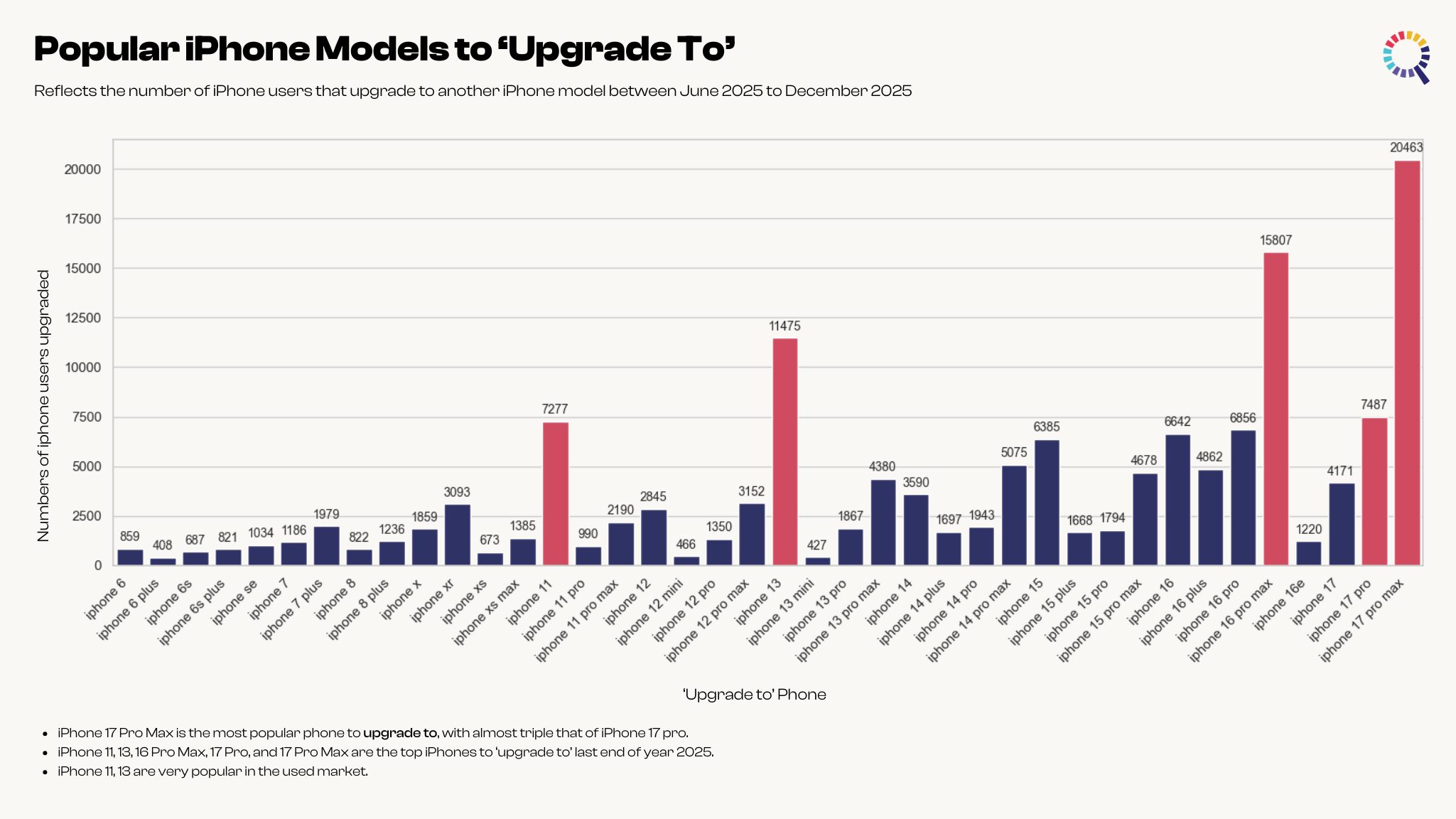
Key Takeaway: The iPhone 11 and 13 remain surprisingly relevant. These models are the “workhorses” of the used market, frequently purchased by users looking for a reliable iOS experience without the flagship price tag.
The ‘Upgraded From’ Leaders: The End of an Era
The most common models being retired in 2025 are the iPhone 11 and iPhone 13. This indicates that users on a 2-to-4-year upgrade cycle are finally moving toward modern hardware.
-
-
iPhone 11: The #1 model being traded in or replaced.
-
iPhone 13: A popular “from” model as users jump to the 17 series.
-
iPhone 14 Pro Max & XR: Significant numbers are also moving away from these older “notch” designs.
-
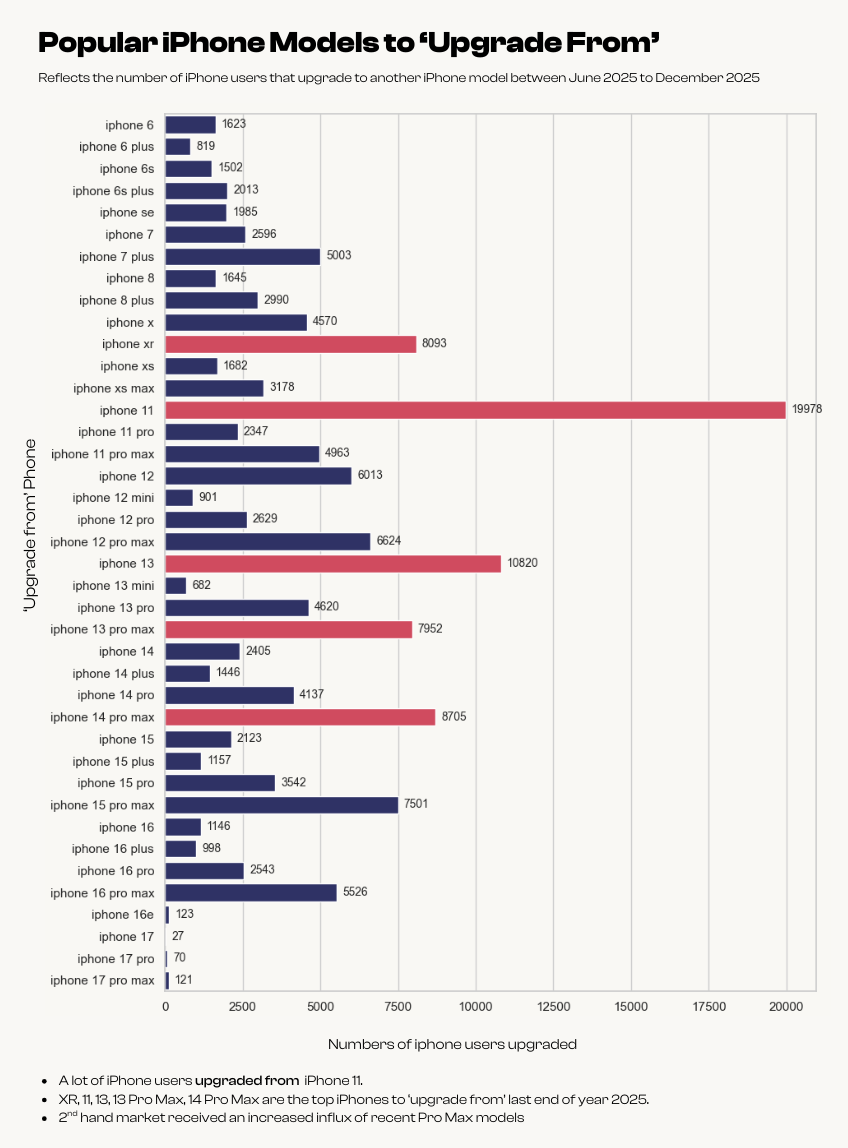
Interesting Trend: The iPhone 13 is unique because it is both a popular model to upgrade from and upgrade to. This suggests a “hand-me-down” economy where older users pass the 13 to family members or sell them into the used market as they move to the iPhone 17.
Analyzing the “Upgrade Path” and Model Stickiness
When we look at the direct paths users take, several behavioral patterns emerge:
1. Lineup Stickiness
Our data reveals a high level of “tier loyalty.” Users who currently own a Pro Max are highly likely to upgrade to another Pro Max. Similarly, base model users tend to stick to the base tier. However, Pro Max loyalty is significantly stronger than base model loyalty.
2. The iPhone 12 “Pandemic Gap”
The iPhone 12 (released in 2020) shows lower upgrade activity compared to the iPhone 11 and 13. This is largely attributed to its launch during the height of the pandemic, which limited retail availability and consumer foot traffic. The iPhone 13, released as restrictions eased, saw much higher adoption, which is reflected in today’s upgrade volumes.
3. The Shift Toward “Bigger is Better”
The iPhone mini has the lowest upgrade interest in our study. This trend explains why manufacturers are favoring larger screens. Consumers are prioritizing:
-
Increased Battery Capacity: Larger chassis allow for more power.
-
Camera Sophistication: More room for advanced lens modules.
-
Screen Real Estate: For better media consumption.
Similarly, the iPhone Plus models see lower adoption, as the price gap between the Plus and the Pro Max often leads consumers to choose the more powerful Pro version.
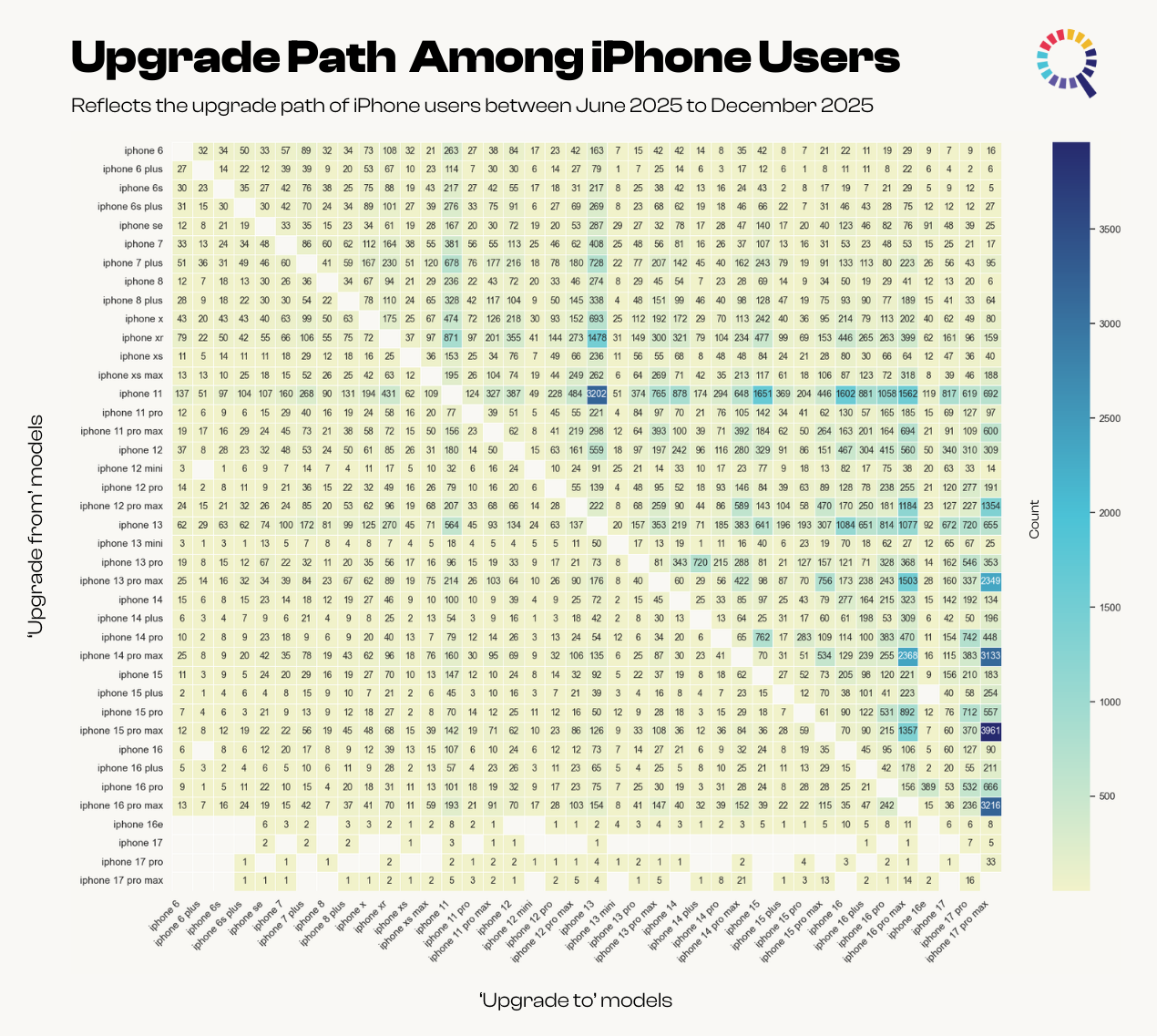
This chart reveals that those that upgraded to iPhone 13, did come from iPhone 11. Some came from a generation before iPhone Xr.
Aside from iPhone 13, those coming from iPhone 11 upgraded to 15, 16, and 16 pro max.
iPhone 12 is not a very popular phone. It was released at the peak of the pandemic back in 2020. Which prevented a lot of people from going to malls, retail shops etc. iPhone 13 was released a year later, with decreased restrictions and so – more units sold.
Analyzing the trend of iPhone 13 reveals the ‘stickiness’ among the lineups. Whereas, if you look closely, those that use the base model are more likely to upgrade to another base model (say from iPhone 13 to iPhone 14). Likewise, those that upgrade to ‘pro max’ models are also from ‘pro max’ models. The ‘pro max’ model stickiness is more prominent than the ‘base’ model.
Summary
iPhones release new devices every year. With relatively easy naming schemes, and widespread use, it is the perfect brand to study smartphone upgrade paths. iPhone 17 Pro Max has been very successful launch from Apple, prompting huge smartphone upgrade numbers. We saw the tendency of people to stick to their current model line (base model to base model, Pro Max to Pro Max). iPhones 11 and 13 has been very popular in the used market. It is interesting to think about how demographics play a role in this, are users in postpaid plans more likely to upgrade faster? How about other brands?
Knowing if a customer will upgrade is one thing, but knowing to which phone they will likely upgrade is very powerful for businesses. This is just a start in our goal to provide in depth insight on the smartphone brands, upgrade trends, and developing a model to predict smartphone upgrade.
If you are interested in our solutions, contact us at info@inquiro.ph.